
Is it possible to use the DMX protocol on a wireless network?
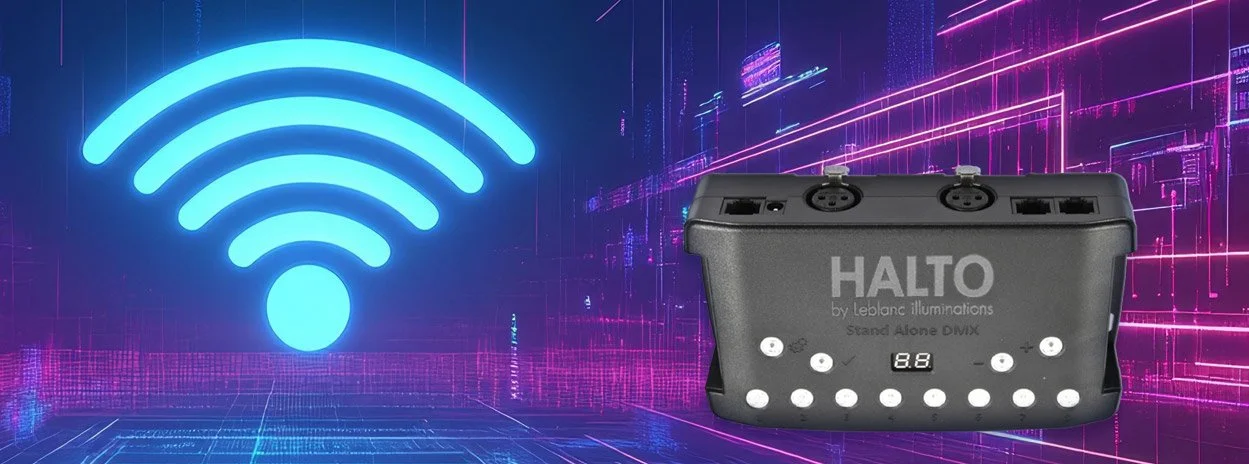
Is wireless lighting possible?


Are you organizing an event, managing a temporary or permanent installation, or looking to illuminate an old building without having to lay cables everywhere? Are you wondering whether the DMX protocol, usually distributed via wires, can work in a version with wireless signal transmission without compromising the performance of your lighting?
Good news: it's perfectly possible. In this article, we explain how DMX with wireless distribution works, its advantages and limitations, and which brands are the most reliable for your needs.
How does wireless DMX work?
Wireless DMX replaces the traditional XLR cable with a radio link between :
A transmitter, connected to your DMX console or controller,
One or more receivers, connected to your luminaires or decoders.
These systems most often operate in the 2.4 GHz band (like Wi-Fi), but some brands also use the 868 MHz or 900 MHz bands, depending on the brand and local regulations.
The advantages of wireless DMX
Fewer cables, more flexibility. Going wireless means :
Reduced installation time, thanks to fewer cables
Fewer physical and aesthetic constraints
Ideal for temporary, outdoor events or heritage buildings where cable routing is a problem

Why didn't I take the time to learn about wireless technology...
Points to watch before choosing
Signal stability is highly dependent on the quality of your equipment. Here's what to look out for:
Radio interference: Wi-Fi, Bluetooth or other devices can interfere with a system if the equipment is not of high quality, if there are obstacles (trees with wet leaves or ice) or if there are unknown changes in the immediate environment.
Latency: This is minimal with a good system, but can become critical if your effects need to be perfectly synchronized.
Range: Depending on the model, this varies from 30 to 300 metres with a clear view.
Compatibility: We recommend that you stick to the same brand of transmitter/receiver, as systems are not always compatible.
Popular wireless DMX brands and technologies
Some manufacturers clearly stand out in terms of reliability and performance. The best known include :
LumenRadio (very high-end, event-driven or long-term projects)
City Theatrical (Multiverse)
Wireless Solution (W-DMX)
ADJ WiFly
Enttec, etc.
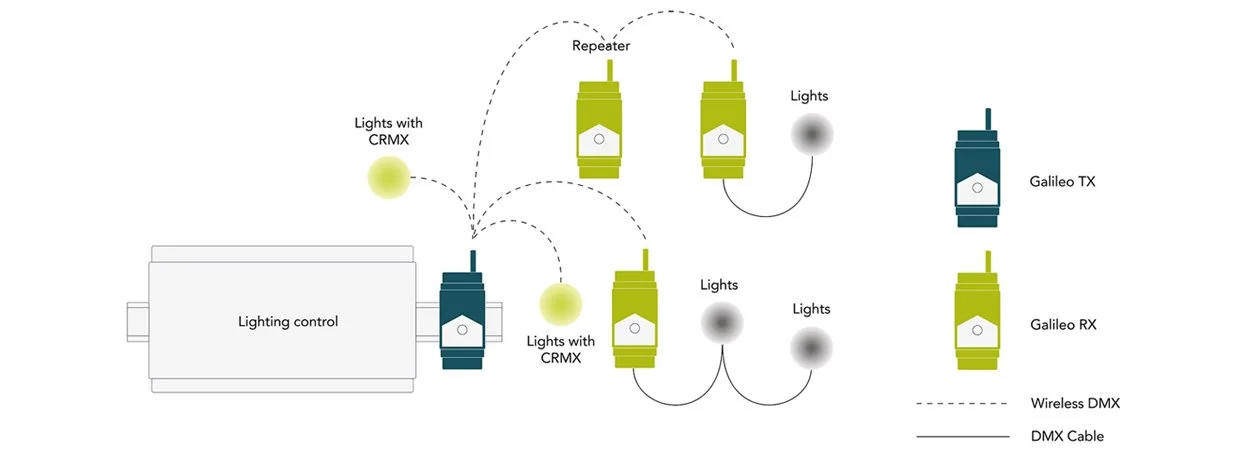
DMX : Technical diagram.
In a nutshell
Yes, wireless DMX is a reliable solution, provided you choose a quality system suited to your environment. Whether to save time, avoid wiring or adapt to complex locations, it's an excellent choice for architectural or event lighting professionals.
Next step : Consult our experts
Are you planning to integrate a wireless DMX solution into your installation?
Download our HALTO catalog and consult our experts, who will be able to recommend the right products for your lighting project, so you can make an informed choice!