
Professional illumination equipment or low-cost big-box equipment? A comprehensive comparison.

Professional equipment vs. supermarkets: balancing price, performance and durability.


Have you spotted low-cost LED garlands in supermarkets or online? The choice may seem simple... but is it really worth it in the long run? Between the promise of savings and the risks of performance, doubts quickly creep in.
At Leblanc Illuminations, we've been supporting cities, festivals and businesses for over 60 years with professional lighting equipment designed to last, perform and secure your installations.
In this article, we compare professional LED string lights point by point with models sold in supermarkets: power supply, quality of components, certifications, durability... You'll know exactly why prices differ and what it means for you.
1. power supply system
The majority of garlands purchased from supermarkets are assembled in such a way that, if one LED bulb fails, an entire section of the garland goes out. This is because the electrical circuit that powers the LED is a series circuit. In contrast, professional-grade equipment uses a parallel circuit, where each LED is powered individually. So, if one LED is faulty, the others continue to work, and the fault goes virtually unnoticed.
2 LED luminescence
Plug in a garland set purchased from a supermarket and a professional-quality garland set, and you'll see the difference! The light emitted by the LED in store-bought garland tends to vibrate and look bland, whereas that of professional garland is stable, bright and brilliant. This is due to the power of LED and the use of a device, a rectifier, which transforms alternating current into direct current. More brilliance and sparkle also means more Wow! effect.
3.component quality
The sheathing gauge of electrical cable and that of copper cable also differ. Professional equipment uses larger, stronger components, ensuring greater durability and resistance to handling and weathering.
4.component assembly
Professional equipment is assembled with greater care. Each LED is soldered directly onto the power cable and encapsulated in a waterproof plastic material. In comparison, large-area festoons use plastic supports without welding or encapsulation, making them more vulnerable to water infiltration and corrosion.
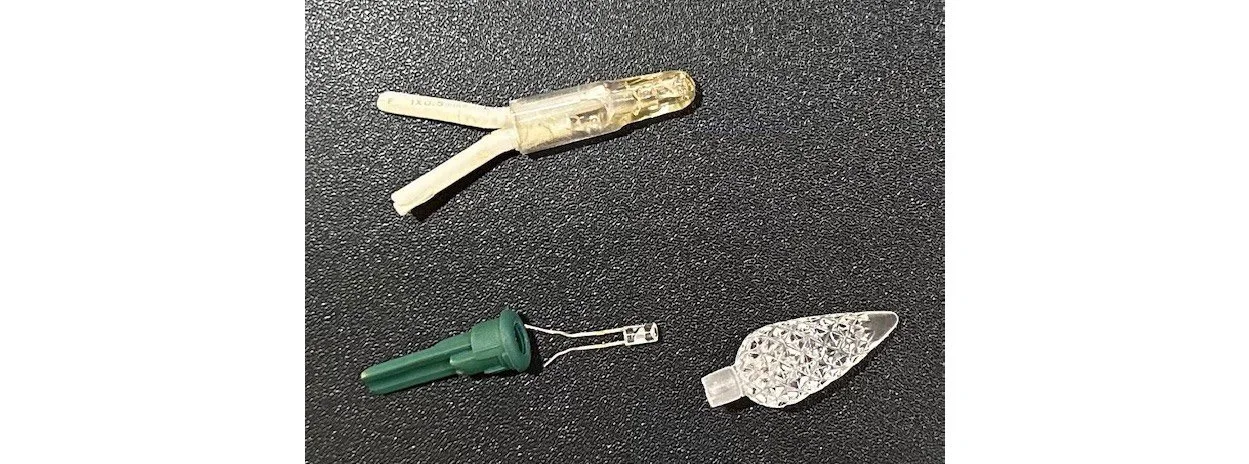
Image above: The bottom LED , typical of large-area products, shows two unsoldered parts, vulnerable to water and corrosion. Above, the professional LED is soldered directly to the cable, ensuring better sealing and durability.
5 Quality control
Distributors of professional lighting equipment are very demanding of their manufacturers. They draw up specifications detailing the technical requirements to ensure the quality and durability of the equipment. Each batch of equipment is sampled and inspected in the laboratory to ensure compliance with specifications.
6.certifications
Two types of certification are important: compliance with Canadian electrical standards (CSA, cUL, cULus, cETLus) and IP protection against solids and liquids. Certified products are designed to operate safely on a Canadian electrical network and comply with current standards.
The IP rating is made up of 2 numbers. The 1st indicates the assembly's protection against the ingress of solid matter, in this case dust, while the second indicates the assembly's protection against the ingress of liquid matter. The first index can vary from 1 to 6, while the second varies from 1 to 8. The table below gives details of each index:
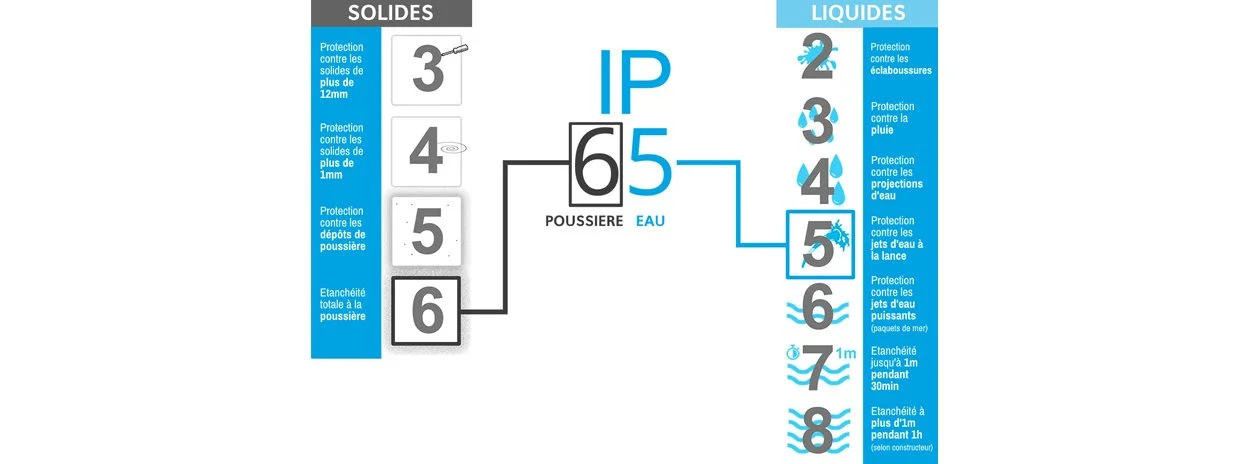
Above: Understanding IP rating - an essential criterion for choosing safe, long-lasting outdoor lighting.
For example, a product with an IP rating of 67 can be safely immersed under 1 meter of water for 30 minutes. As these are not normal conditions of use, an IP rating of 44, which provides protection against dust particles larger than 1mm and protection against splashing water (very heavy rain), is sufficient for any kind of lighting equipment installed outdoors and not at risk of being submerged.
7 Animation options
Professional equipment suppliers offer animation options such as sparkling, crackling, spinning or RGB with a variety of effects. These options are harder to find in big-box stores. For example, some professional suppliers will offer animation options for their garlands, such as flickering (around one in five LED bulbs are cool white and flicker randomly, creating a flickering effect) or crackling (between 20% and 30% of LED bulbs are cool white and flicker rapidly and randomly, creating a crackling effect). Some of the garlands available in supermarkets can also offer certain animation options, but it's harder to find garlands with a flickering or crackling effect in big-box stores, whereas they're commonplace with professional suppliers.
Now that you understand the 7 major differences between a professional LED garland and a large-area version, you're better equipped to make an informed choice according to your priorities: durability, safety, aesthetics or technical performance.
The question of price often conceals much more important issues: component quality, electrical safety, weather resistance and luminous rendering. A low initial purchase cost can lead to much higher replacement or maintenance costs in the medium term.
Planning an illumination project? Contact our team for personalized support, to discover our range of certified professional products and choose the solution best suited to your needs and budget.