
Canadian standards for Christmas decorations in shopping malls: What you absolutely must comply with
Knowing and complying with Canadian regulatory requirements helps avoid costly penalties.


Every holiday season, Christmas decorations are installed in shopping malls without fully complying with all safety standards. This situation can pose serious risks to public safety, but also significant financial losses for owners and managers, particularly in the event of temporary closures imposed by the authorities.
Whether you are a property owner, building manager, operator, or decorator, knowing Canada's regulatory requirements is essential to avoid costly penalties. This guide summarizes the most important standards to comply with according to the National Fire Code of Canada (NFCC) as well as the municipal regulations most frequently applied across the country.
Here you will find the six main categories of standards that must be complied with: fire safety, electricity, materials, installation, public safety, and required documentation. Essential reading before installing Christmas decorations in a commercial space.
1. Fire safety standards (mandatory)
Fire safety is the top priority in shopping centers. All decorations must comply with CNPI requirements, particularly with regard to the materials used.
Decorative elements must be made from fire-retardant or flame-resistant materials with a recognized classification such as CAN/ULC-S109 for fabrics, garlands, and artificial trees.
It is strictly prohibited to obstruct:
emergency exits,
smoke detectors,
the sprinklers,
evacuation corridors.
Some municipalities also require:
fireproofing certificates,
fire resistance tests,
a preliminary inspection before opening to the public.
2. Electrical standards (lights and motorized components)
Any decoration containing an electrical system must comply with the Canadian Electrical Code (CSA C22.1). Only CSA, ULc, or ETL certified products are permitted. Electrical wiring must be protected and inaccessible to the public in order to eliminate any risk of contact or damage.
LED lights are highly recommended due to their low heat emission. The use of low-voltage equipment (24 V or 36 V) also significantly reduces risks.
To be avoided at all costs:
uncertified or excessively long extension cords (over 30 meters),
damaged, tampered with, or modified wires.
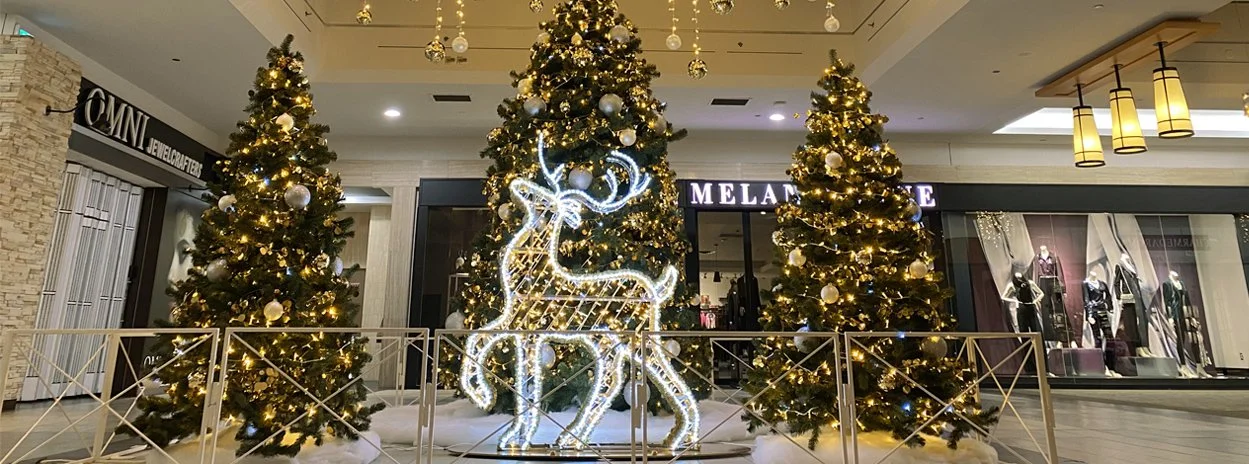
Above: The sparkling reindeer and three illuminated Christmas trees light up the Carlingwood Shopping Center.
3. Decorative materials: what is permitted and prohibited
The choice of decorative materials is strictly regulated.
Permitted materials:
fire-retardant plastics,
fabrics treated with flame retardants,
wood treated or varnished with fire retardants,
light metals that comply with load standards.
Prohibited materials:
non-fireproof foam,
straw, hay, and dry natural materials,
untreated expanded polystyrene,
any object that produces sparks or excessive heat.
4. Structural and installation standards
Suspended elements must comply with the maximum structural loads permitted by the building. All installations must be carried out by qualified professionals or approved by the shopping center's engineering department.
No component shall present a risk of:
fall,
pinching,
tilting.
The stability of installations is a regulatory requirement.
5. Public safety
Visitor safety remains a constant priority. No sharp, flammable, or dangerous items should be accessible, especially to children.
Interactive decorations must be stable, tested, and secure. Photo areas, such as those dedicated to Santa Claus, must comply with CSA B651 standards regarding accessibility for people with reduced mobility.
6. Documents often required by the authorities
Before installation, several documents may be required:
material fireproofing certificate,
technical data sheets for electrical products,
detailed installation plans,
proof of civil liability insurance for the manufacturer and installer,
report or approval from the local fire department.
In conclusion
Complying with Canadian standards for Christmas decorations in shopping centers is not a mere formality. It is an essential requirement for ensuring visitor safety, preserving the establishment's reputation, and avoiding costly penalties.
Every year, non-compliant installations result in fines, the removal of decorations, and, in some cases, serious accidents. A single mistake can damage the image of an entire shopping center.
Before any installation, review this list, contact local authorities, and request the appropriate certificates from your suppliers. This guide is designed to help you anticipate regulatory requirements, ensure compliance, and create a festive atmosphere that is both attractive and safe.